Log in
Sign up for FREE
arrow_back
Library

2019 (Jun.): NY Regents - Global History & Geography II

star
star
star
star
star
Last updated 3 months ago
36 questions
Part I
Directions (1–28): For each statement or question, choose the word or expression that, of those given, best completes the statement or answers the question.
Base your answers to questions 1 and 2 on the passage below and on your knowledge of social studies.

In the very heart of Tokyo sits the imperial palace, site of the former Edo Castle. Inside a colossal moat with ramparts that dwarf anything seen in Europe, vast open spaces enclose the last fragments of one of the world’s most imposing seventeenth-century monuments. Across the globe in France, Louis XIV’s palace and gardens of Versailles form a similar impression of artificial mastery of nature and society. Miles of formal gardens punctuated [decorated] with fountains and statuary surround a palace known for its cold magnificence, with the entire ensemble of town, palace, and park orienting itself around a single, central focal point: the Sun King’s bedroom. Each complex symbolizes a system of power. Edo evokes [brings to mind] the Tokugawa rule by status, which decreed that the daimyo lords, who were themselves forced to spend alternate years in Edo away from their regional domains, lived administratively and spatially segregated from the various other categories of subjects, all ranged in a pattern of residential sectors spiraling around the castle. Versailles, in similar fashion, bespeaks [indicates] the domestication of the French aristocracy in a “gilded cage,” where they scrambled for favors while the Sun King undermined their authority and deprived them of their independence.
— William Beik, “Louis XIV and the Cities,” Edo and Paris: Urban Life and the State in the Early Modern Era, Cornell University Press, 1994
1
10.1.a.iii
1
10.1.a.ii
Base your answers to questions 3 and 4 on the documents below and on your knowledge of social studies.

1
10.2.b.i
1
10.2.c.i
Base your answers to questions 5 and 6 on the passage and illustration below and on your knowledge of social studies.

1
10.3.d.ii
1
10.3.d.ii
Base your answers to questions 7 and 8 on the passage below and on your knowledge of social studies.
... At times, gas has been known to travel, with dire results, fifteen miles behind the lines.
A gas, or smoke helmet, as it is called, at the best is a vile-smelling thing, and it is not long before one gets a violent headache from wearing it.
Our eighteen-pounders were bursting in No Man's Land, in an effort, by the artillery, to disperse the gas clouds.
The fire step was lined with crouching men, bayonets fixed, and bombs near at hand to repel the expected attack.
Our artillery had put a barrage of curtain fire on the German lines, to try and break up their attack and keep back re-inforcements.
I trained my machine gun on their trench and its bullets were raking the parapet [spraying the wall].
Then over they came, bayonets glistening. In their respirators, which have a large snout in front, they looked like some horrible nightmare. ...
Arthur Empey, "Over the Top," G. P. Putnam's Sons, 1917
1
10.5.a.i
1
10.5.a.i
Base your answers to questions 9 and 10 on the illustration below and on your knowledge of social studies.
1
10.5.d.i
1
10.5.d.i
Base your answers to questions 11 through 13 on the timeline below and on your knowledge of social studies.


1
10.6.a.i
1
10.6.b.iv
1
10.6.b.i
Base your answers to questions 14 and 15 on the passage below and on your knowledge of social studies.
For a fortnight Gandhi’s march is intended to be only a demonstration. Then, when he expects to be at the sea, he will begin to produce salt from brine [salt water], and so infringe [violate] the Government salt monopoly, defying the Government to arrest and punish him. At the same time his supporters everywhere have been incited by him to refuse to pay local taxes.
— Gandhi’s March to the Sea, The Guardian, 1930
1
10.7.a.i
1
10.7.a.i
Base your answers to questions 16 and 17 on the passage below and on your knowledge of social studies.
...History shows that wars are divided into two kinds, just and unjust. All wars that are progressive [reformist] are just, and all wars that impede [obstruct] progress are unjust. We Communists oppose all unjust wars that impede progress, but we do not oppose progressive, just wars. Not only do we Communists not oppose just wars, we actively participate in them. As for unjust wars, World War I is an instance in which both sides fought for imperialist interests; therefore the Communists of the whole world firmly opposed that war. The way to oppose a war of this kind is to do everything possible to prevent it before it breaks out and, once it breaks out, to oppose war with war, to oppose unjust war with just war, whenever possible...
— Mao Zedong, Quotations from Chairman Mao Tse-Tung, Foreign Languages Press, Peking, 1966
1
10.7.d.ii
1
10.7.d.ii
Base your answers to questions 18 and 19 on the cartoon below and on your knowledge of social studies.
1
10.8.b.i
1
10.8.b.i
1
10.6.c.ii
1
10.9.d.iii
1
10.9.d.iii
Base your answers to questions 23 and 24 on the photographs below and on your knowledge of social studies.
1
10.10.a.i
1
10.10.c.i
Base your answers to questions 25 and 26 on the cartoon and excerpt below and on your knowledge of social studies.

1
1
Base your answers to questions 27 and 28 on the passage below and on your knowledge of social studies.

The genius of apartheid was convincing people who were the overwhelming majority to turn on each other. Apart hate, is what it was. You separate people into groups and make them hate one another so you can run them all.
At the time, black South Africans outnumbered white South Africans nearly five to one, yet we were divided into different tribes with different languages: Zulu, Xhosa, Tswana, Sotho, Venda, Ndebele, Tsonga, Pedi, and more. Long before apartheid edited these tribal factions classes and warred with one another. Then white rule used that animosity [hatred] to divide and conquer. All nonwhites were systematically classified into various groups and subgroups. Then these groups were given differing levels of rights and privileges in order to keep them at odds...

- Trevor Noah, Born a Crime: Stories from a South African Childhood. Spiegel & Grau, 2016
1
10.10.c.iii
1
10.10.c.iii
Part II
These questions are based on the accompanying documents and are designed to test your ability to work with historical documents. Each Constructed Response Question (CRQ) Set is made up of 2 documents. Some of these documents have been edited for the purposes of this question. Keep in mind that the language and images used in a document may reflect the historical context of the time in which it was created.

In developing your answers to Part II, be sure to keep these explanations in mind:
  • Identify—means to put a name to or to name.
  • Explain—means to make plain or understandable; to give reasons for or causes of; to show the logical development or relationship of something.
Short-Answer CRQ Set 1 Structure
  • Question 29 uses Document 1 (Context)
  • Question 30 uses Document 2 (Source)
  • Question 31 uses Documents 1 and 2 (Relationship between documents)
Short-Answer CRQ Set 2 Structure
  • Question 32 uses Document 1 (Context)
  • Question 33 uses Document 2 (Source)
  • Questions 34a and 34b use Documents 1 and 2 (Relationship between documents)
CRQ Set 1 Directions (29-31): Analyze the documents and answer the short-answer questions that follow each document in the space provided.

Base your answer to question 29 on Document 1 below and on your knowledge of social studies.
1
10.4.a.ii
Base your answer to question 30 on Document 2 and on your knowledge of social studies.
1
10.7.a.i
1
CRQ Set 2 Directions (32–34b): Analyze the documents and answer the short-answer questions that follow each document in the space provided.

Base your answer to question 32 on Document 1 and on your knowledge of social studies.
1
10.7.d.ii
Base your answer to question 33 on Document 2 and on your knowledge of social studies.
1
10.7.d.ii
1
10.7.d.i
All five documents are in the window at the left.
1
0
Question 1
1.

Question 2
2.

Question 3
3.

Question 4
4.

Question 5
5.

Question 6
6.

Question 7
7.

Question 8
8.

Question 9
9.

Question 10
10.

Question 11
11.

Question 12
12.

Question 13
13.

Question 14
14.

Question 15
15.

Question 16
16.

Question 17
17.

Question 18
18.

Question 19
19.

Base your answers to questions 20 through 22 on the passage below and on your knowledge of social studies.
. . . Yet in recent months something has changed. Kim Jong Il, whose regime was responsible for the first test and who died in 2011, had only a rudimentary [basic] nuclear device, useful mainly for blackmail. Under his son, Kim Jong Un, the programme has rapidly gathered pace, with two nuclear tests this year alone. The North has also conducted 21 missile tests this year, including one from a submarine—a first. The ability to miniaturise a tactical nuclear weapon on a working missile could be just two or three years away, with an intercontinental ballistic missile capable of hitting California possible in five years’ time. Chun Yung-woo, a South Korean former national security adviser, talks of “growing outrage. . . after five tests, a change of mood, a sense of urgency.”
Once, it was possible to hope that the North’s isolated regime would implode [fail] under its own contradictions before it gained a proper nuclear capability. But the spread of informal markets and, for some North Koreans, a measure of prosperity may have strengthened the regime’s chances of survival. A consensus in Seoul is forming that Mr Kim now aims to dictate events on the peninsula—including the ability to demand that the Americans leave. One senior foreign diplomat in Seoul says that for the first time he hears people wondering openly whether there will be a major conflict on the peninsula in their lifetime. . . .
— “A Shrimp Among Whales,” The Economist, October 27, 2016
Question 20
20.

Question 21
21.

Question 22
22.

Question 23
23.

Question 24
24.

Question 25
25.

Question 26
26.

Question 27
27.

Question 28
28.

Question 29
29.

Explain the historical circumstances that led to British attitudes about their empire as shown in this excerpt from An ABC for Baby Patriots.

Question 30
30.

Identify Jawaharlal Nehru’s point of view concerning British colonialism in India based on this excerpt.

Base your answer to question 31 on both Documents 1 and 2 and on your knowledge of social studies.

Cause—refers to something that contributes to the occurrence of an event, the rise of an idea, or the bringing about of a development.
Effect—refers to what happens as a consequence (result, impact, outcome) of an event, an idea, or a development.
Question 31
31.

Identify and explain a cause-and-effect relationship associated with the historical developments in documents 1 and 2. Be sure to use evidence from both documents 1 and 2 in your response.

Question 32
32.

Explain the historical circumstances that led to the developments discussed in this excerpt from “China’s Foreign Policy.”

Question 33
33.

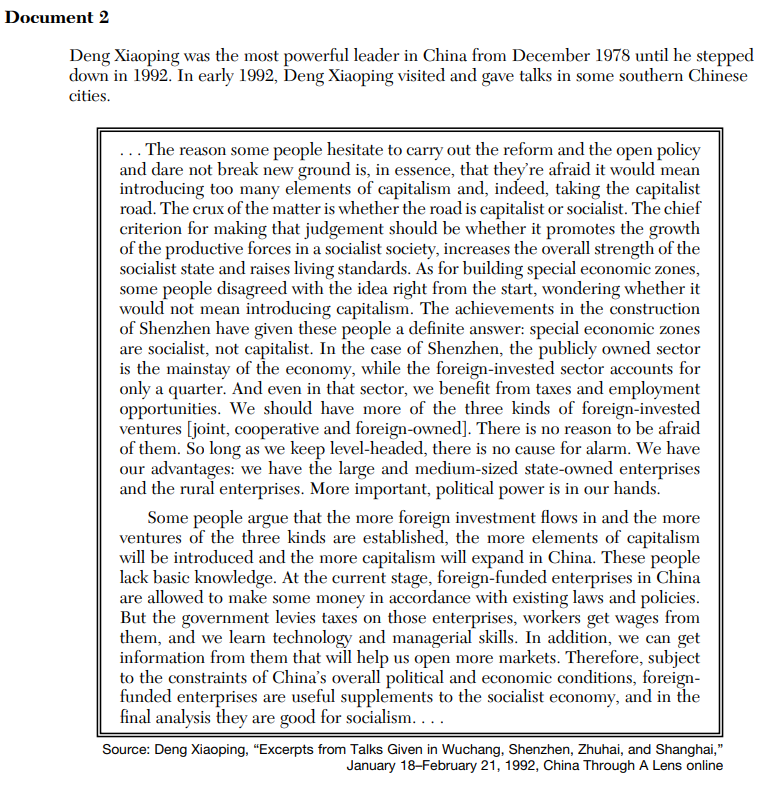
Based on this excerpt, explain the purpose of Deng Xiaoping’s speech which addresses reform and the open policy in China.

Similarity- Tells how something is alike or the same as something else.
Difference- Tells how something is not alike or not the same as something else.
Question 34
34.

Using evidence from both Documents 1 and 2 and your knowledge of social studies:
a) Identify a similarity or a difference between the economic development policies of Mao Zedong and those of Deng Xiaoping.
b) Explain the similarity or difference you identified using evidence from both documents.

Part III (Question 35) ENDURING ISSUES ESSAY

This question is based on the accompanying documents. The question is designed to test your ability to work with historical documents. Some of these documents have been edited for the purposes of this question. As you analyze the documents, take into account the source of each document and any point of view that may be presented in the document. Keep in mind that the language and images used in a document may reflect the historical context of the time in which it was created.

Directions: Read and analyze each of the five documents and write a well-organized essay that includes an introduction, several paragraphs, and a conclusion. Support your response with relevant facts, examples, and details based on your knowledge of social studies and evidence from the documents.

An enduring issue is a challenge or problem that has been debated or discussed across time. An enduring issue is one that many societies have attempted to address with varying degrees of success.

Task:
• Identify and explain an enduring issue raised by this set of documents
• Argue why the issue you selected is significant and how it has endured across time using your knowledge of social studies and evidence from the documents

In your essay, be sure to
• Identify the enduring issue based on a historically accurate interpretation of at least three documents
• Define the issue using relevant evidence from at least three documents
• Argue that this is a significant issue that has endured by showing:
– How the issue has affected people or has been affected by people
– How the issue has continued to be an issue or has changed over time
• Include relevant outside information from your knowledge of social studies

In developing your answer to Part III, be sure to keep these explanations in mind:
Identify—means to put a name to or to name.
Define—means to explain features of a thing or a concept so that it can be understood.
Argue—means to provide a series of statements that provide evidence and reasons to support a conclusion.
Documents 1 (Scroll further down for Documents 2-5)

Document 2


Documents 3

Document 4

Document 5

Question 35
35.

Write your essay here following the detailed instructions above.

Directions: Read and analyze each of the five documents and write a well-organized essay that includes an introduction, several paragraphs, and a conclusion. Support your response with relevant facts, examples, and details based on your knowledge of social studies and evidence from the documents.

Question 36
36.

Optional Planning Page

Based on this passage, one way the castle at Edo and the palace at Versailles are similar is that both
became symbols of power and wealth
developed into monastic centers of learning
were meant to provide protection and prevent attacks
served as monuments to the military
Which claim can best be supported by this passage?
The more independent the nobles were the higher their status.
Nobles maintained their authority by remaining isolated.
Rulers controlled their nobles by influencing where they lived.
Spending time in segregated sectors guaranteed nobles the support of their ruler.

Which political philosophy is best supported by both documents?

Rule of law represents a social contract with the people.
Tyranny encourages liberty and security.
Separation of powers guarantees people fair treatment.
Oppression promotes the general will.

Which event most directly influenced the writing of both documents?

Iranian Revolution
Cuban Revolution
French Revolution
Russian Revolution
What is the most likely purpose of this document?
to highlight the benefits of free market
to record the negative effects of child labor
to minimize the impacts of agricultural innovations
to inspire social and political reform
The conditions described in this passage directly resulted in
Ireland invading Britain
millions of Irish emigrating to the United States
most landlords forgiving the rent the Irish owed
Britain agreeing to withdraw from Ireland
A historian could best use this passage to study which topic of World War I?
events that started the war
impact of combat on civilians
equipment utilized by soldiers
propaganda that supported the war effort
Which claim can best be supported by this passage?
New technology made warfare more destructive.
Warfare had a limited impact on the environment.
Countries engaged in war were punished for their actions.
Illness and disease took many lives.
Which point of view is expressed in this illustration?
The Russian Orthodox Church caused the fall of the Romanov dynasty.
The Russian government encouraged a diversity of opinions.
The Romanovs suppressed Enlightenment ideas within their empire.
The Russian Revolution made conditions worse for most minorities.
Which long-term historical circumstance about Russia is shown in this illustration?
Appeal of Marxism to the Russian nobles
Autocratic rule of Russian royalty
Rejection of the Pan-Slavism movement
Support of the Russian Orthodox Church for democratic ideals
Which foreign policy action best explains the United States response to Cold War situations?
repeated reliance on appeasement
consistent attempts to bring about détente
a continuing pursuit of nonalignment
a long-term commitment to containment
Which belief best supports the pattern of interaction between the United States and the Soviet Union between 1948 and 1979?
Conflict occurred when one side tried to expand its sphere of influence into another country or region.
Disagreements between the United States and the Soviet Union were quickly resolved without the deployment of the military.
Leaders of other countries encouraged conflict between the superpowers.
Peace and stability were created around the world as a result of the alliance between the United States and the Soviet Union.
Which document would best provide information about the impact these events had on regions other than the United States and the Soviet Union?
Russian textbook published in 2015
television interview with President John F. Kennedy
memoirs of people living in East Germany, Cuba, and Afghanistan
line graph of the Soviet Union’s gross domestic product between 1948 and 1968
The actions taken by Gandhi reflect his commitment to which policy?
collectivization
religious intolerance
civil disobedience
censorship
The actions of Gandhi and his supporters, as described in this passage, helped lead to the
banning of Western books and music
removal of British control from the subcontinent
development of an economic alliance for South Asian nations
peaceful partitioning of British India into India and Pakistan
Based on this passage, what does Mao believe about war from the communist perspective?
Wars are inevitable regardless of the society.
Wars can be just or unjust depending on their purpose.
Wars have a purpose in all societies because of a constant need for change.
Wars should be permitted when a government needs to obstruct progress.
Based on this passage, what does Mao believe about World War I?
The philosophical beliefs of the competing countries challenged traditional ideals.
The potential political gains of European nations benefited China.
The countries in the war were involved for their individual economic benefits.
The possible military losses made it too risky for the Communist Party to intervene.
Which leader’s political legacy most directly influenced the situation shown in this 2004 cartoon?
Ayatollah Khomeini
Slobodan Milošević
Augusto Pinochet
Kemal Atatürk
What is the main idea of this 2004 cartoon?
Iran continues to build its modern infrastructure.
Iran is experiencing tensions between tradition and modernity.
Extensive ballot choices have weakened democracy in Iran.
Theocracy is the best form of government for Iran to adopt.
The tensions between North Korea and South Korea described in this passage began over
boundaries drawn during the Cold War
ethnic conflict on the Korean peninsula
trade disputes centered on fishing rights in the Yellow Sea
China’s purchase of submarine technology from North Korea
Based on this passage, in which way is the situation in the Korean peninsula comparable to the history of South Asia since World War II?
Peaceful protests led colonial powers to surrender their control of the region.
Increased prosperity has accompanied a shift from totalitarian to democratic rule.
Regional conflicts have contributed to the proliferation of nuclear weapons.
Technological progress reduced tension and led to improved trade relationships.
Which claim is best supported in this passage?
An arms race will help defuse tensions on the Korean peninsula.
Economic cooperation between the two Koreas would spread democracy to the North.
An invasion by the United States could remove Kim Jong Un from power with few casualties.
North Korea’s successful military tests have increased the likelihood of war.
Based on these photographs, which action taken by the governments of Chile and Argentina violated the principles of the Universal Declaration of Human Rights?
conducting trials by juries
blowing up factories
arresting known criminals
kidnapping political opponents
In which way are the situations shown in these photographs similar?
Military regimes overthrew democratically elected leaders in both countries.
The United Nations sent peacekeeping forces that provided aid in both countries.
Marxist parties removed the military leaders holding power in both countries.
Foreign armies led invasions in both countries.
This cartoonist is comparing Vladimir Putin to
Czar Nicholas II
Joseph Stalin
Mikhail Gorbachev
Boris Yeltsin
Which earlier historical development best reflects Putin's strategy for rebuilding Russia's prestige in the world?
granting of independence to former Soviet republics
removal of Soviet troops from Afghanistan
lifting of the Berlin blockade
installation of communist regimes throughout Europe
According to this author, how did the minority white population maintain control over the majority black population in South Africa?
through military conscription of black South Africans
through divide and conquer techniques that kept tribes at odds
by enforcing the use of tribal languages so that tribes could not communicate
by allowing democracy within localized areas in the black South African community
Since the end of apartheid, which problem continues to exist in South Africa?
inability of nonwhites to vote in elections
restricting educational instruction to Afrikaans
monopolizing of political power by white South Africans
persistence of segregation as a result of economic inequalities